ao link

What's in store for EU grains in 2026-27 - according to the USDA

• Fertiliser and diesel prices fall again. What now?

• Barley prices underperform in the UK, but not in the EU
• USDA’s first glimpse at 2026/27 EU barley, rapeseed and wheat outlooks 
EUUKpricegrid 13.05.26

Price moves


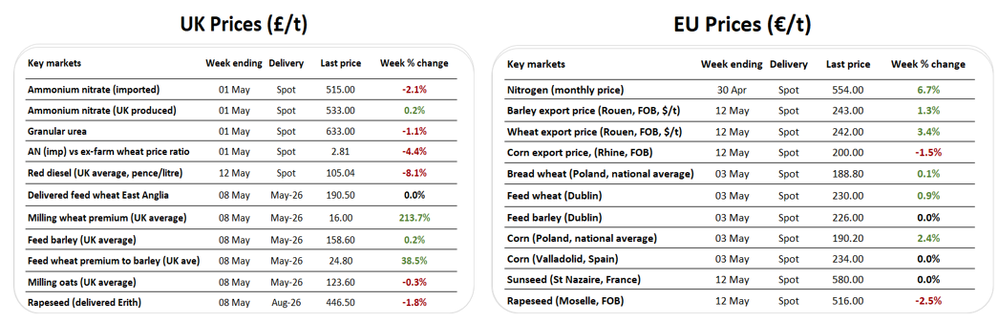
*Fertiliser and diesel prices have continued their retreat from highs reached earlier in the Iran war. In the UK, imported ammonium nitrate declined by £11/t in the last week of April to £515/t, taking to £20/t its retreat from its early-April high, although remaining more than £100/t above pre-war levels.


Red diesel prices fell by 9.20p/l in the week to Tuesday to 105p/l, the lowest since 6 March, and down by nearly one-quarter from their 10 March high.


Prices have now given back about half of their Iran war gains. 


However, analysts increasingly foresee oil prices remaining high for the rest of 2026, largely thanks to continued disruption in the Strait of Hormuz, suggesting that diesel prices may hang on to much of their headway.


JP Morgan this week forecast Brent crude averaging $103/Bbl in the current April-to-June quarter, $104/Bbl in the July-to-September period and $98/Bbl in the last three months of 2026.


The feed barley discount to feed wheat has widened in the UK, even as it remains unusually narrow in the EU. Barley is even in Rouen retaining a premium.


At £24.8/t, the UK discount has widened to a six-month high, reflecting a reduction in feed use, encouraged by higher prices earlier in the season, as well as the distilleries downturn encouraged by the cost of living crisis, lower drinking rates among Generation Z and by US import taxes. UK barley use for making alcohol and malt tumbled by 23% year on year in March, to 124.7Kt.


EU prices, by contrast, remain buoyed by strong exports, up 80% to 8.2Mt (excluding malt) so far in 2025/26. Imports, however, remain weak, down by 47% to 454.9Kt, limiting the spread of EU price firmness to the UK, a key barley exporter to the Continent.


USDA’s first look at EU 2026/27 grain prospects

EUwheatoutput 13.05.26

The turn wetter in Europe’s weather has underpinned prospects of strong, although not record, grain harvests this year, the USDA said in its first 2026/27 forecasts.


The USDA - in its May Wasde report, which issued initial global crop supply and demand estimates for next season – said that while “dryness during March and April depleted soil moisture… precipitation returned in early May, providing welcome relief”.


This was particularly the case in “north eastern [EU] countries, where dryness was becoming most prevalent”.


The conditions meant that crops were “currently in good condition across the EU”, the USDA, pegging the all-wheat harvest at 136.0Mt, a figure in line with the market consensus. (The figure includes a durum harvest estimated by analysts at about 8Mt.) 


That would represent a 9.1Mt retreat from last year’s bumper crop, but remain 3.0Mt above the 10-year average.


The USDA flagged a retreat in all-wheat plantings, saying that “farmers sowed less grain as they continued moving towards crops with higher profit margins or requiring less fertiliser, such as sunflowers and tree crops”.


EUrapeseedproduction 13.05.26

Land had also gone to rapeseed, encouraged by “relatively attractive” prices, as well as drought tolerance, notably compared with corn, “whose yield has taken a beating in recent successive years of heat waves and drought in southeast Europe”.


EU rapeseed output was forecast growing by 180Kt year on year to 20.7Mt, also backed by May rains.


For barley, the USDA forecast a 3.2Mt retreat in output, to 53.2Mt, from last year’s 10-year high. The harvest will nonetheless remain 1Mt above the 10-year average.


Corn production was seen recovering by 700Kt to 57.5Mt, assuming a return to trend yield offsets a cut in area of 390Kha to 7.8Mha, the smallest since at least the 1990s, reflecting concerns over fertiliser prices and weather.


EU area of cheaper-to-grow sunflowers, by contrast, was pegged up 270Kha at 4.9Mha, the second largest on record, putting the bloc on track for a 9.9Mt harvest, up 1.2Mt year on year.


Trade impact

EUwheatexports 13.05.26

The USDA forecast a recovery in 2026/27 EU all-wheat exports of 500Kt to 31.0Mt, despite the smaller harvest, supported instead by “large carryover supplies”.


This suggests a need for competitiveness in EU prices. This is especially so given expectations of an improved pace in shipments from Russia, seen growing by 1.0Mt to a three-year high of 47.0Mt, and strong harvests which will reduce import needs in some major EU customers.


Morocco’s wheat imports are forecast near-halving to 4.0Mt, with Algerian and Egyptian needs seen shrinking too. UK imports will shrink by 1.0Mt to 2.5Mt on a “larger crop” itself, pegged at 13.5Mt.


EU barley exports are expected to ease by 100Kt to 7.5Mt, limited by a smaller crop.


However, competition from other major origins is expected to shrink, thanks to weaker harvests, notably in Australia, where barley output is forecast shrinking by 2.2Mt to “normal” levels of 14.1Mt.


Reduced competition could herald relative firmness in barley prices, as seen this season.


The USDA forecast EU rapeseed imports ticking 250Kt higher in 2026/27 to 5.8Mt, despite the strong harvest, to meet a crush of 25.1Mt, the strongest in 12 years.


This suggests price firmness, to encourage imports, although expectations of a strong 4.2Mt harvest in Ukraine, the default origin for Europe’s early-season purchases, and decent availability in Australia and Canada may put a cap on price support.


Weather outlook

EUweather 07.05.26

Europe faces a wet week ahead, before a return to drier conditions for late May and into early June.


Rains will be widespread over the next week, and in some areas generous, including in southern France and the western UK, as well as in eastern countries such as Romania.


However, dry weather will set into western Europe in the last week of the month, and is forecast by ECMWF weather maps spreading into eastern areas too as June begins. 


Rainfall levels should then prove average at best through Europe well into June.


The conditions suggest further benign growing conditions for both winter and spring crops. A warm finish to May will boost crop development too.


Data

Related Content

EU 2026/27 crop estimates

EU 2026/27 crop estimates

Grain Outlook Video - Geopolitics, Inputs & Grain - Harvest Begins

Grain Outlook Video - Geopolitics, Inputs & Grain - Harvest Begins

Weekly Grains Outlook

Weekly Grains Outlook

Newsflash: Wheat tests key levels

Newsflash: Wheat tests key levels

Need to ask an analyst?

Need to ask an analyst?

Daily Market News

A daily summary of key analysis, prices and factors driving markets
Need to ask an analyst?

Need to ask an analyst?