ao link

April Wheat Price Forecasts - 'Oversupplied' market squares up to tighter outlook

•    Wheat ’oversupply’ breaks grain’s historical correlation with oil
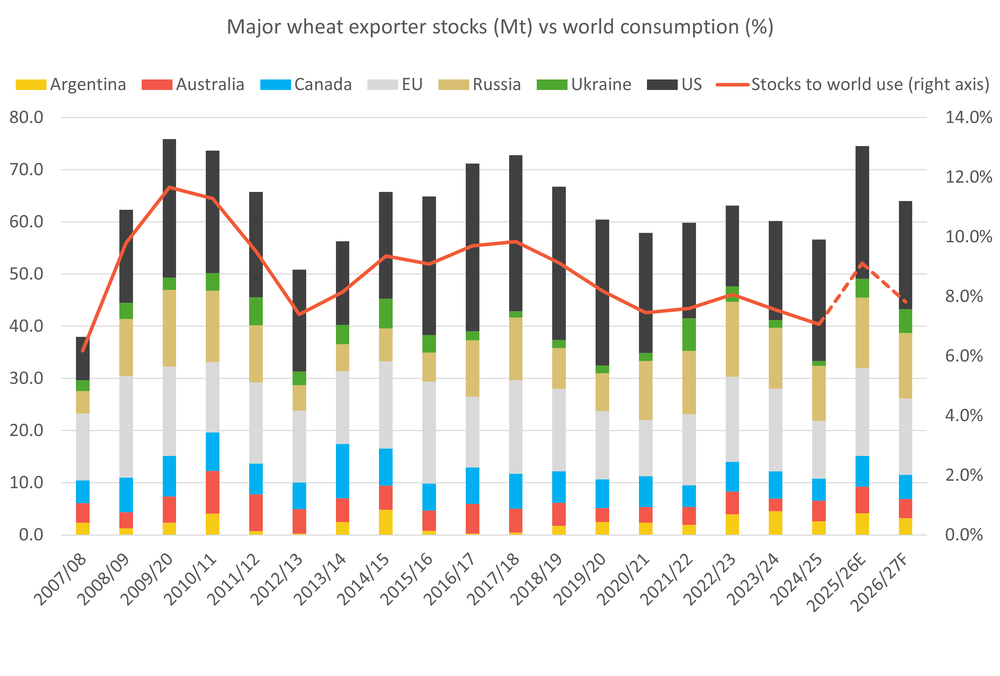
•    Exporter stocks upgraded to most comfortable in eight years
•    However, tightening in supplies likely in 2026/27

•    Changes in US price spreads signs of market rethink
 

wheatexporterstocks 16.04.26
Aprilpriceforecasts 16.04.26

Geopolitics aside, wheat markets are finding the burden of, expanding, supply ideas difficult to shift


History, and Chicago wheat’s 80% price correlation with Brent crude so far this century, suggested that the grain would find support from the Iran war.


Indeed, this was a trade that lured funds into covering their large short bet on wheat, to turn net long in Chicago futures as of the end of last month for the first time in nearly four years.


However, as it stands, wheat prices have, six weeks in, proved little changed by the conflict, for a few reasons.


Other influences have held sway, allowing the ratio of wheat prices to crude oil ones to tank to levels not seen in 12 years.


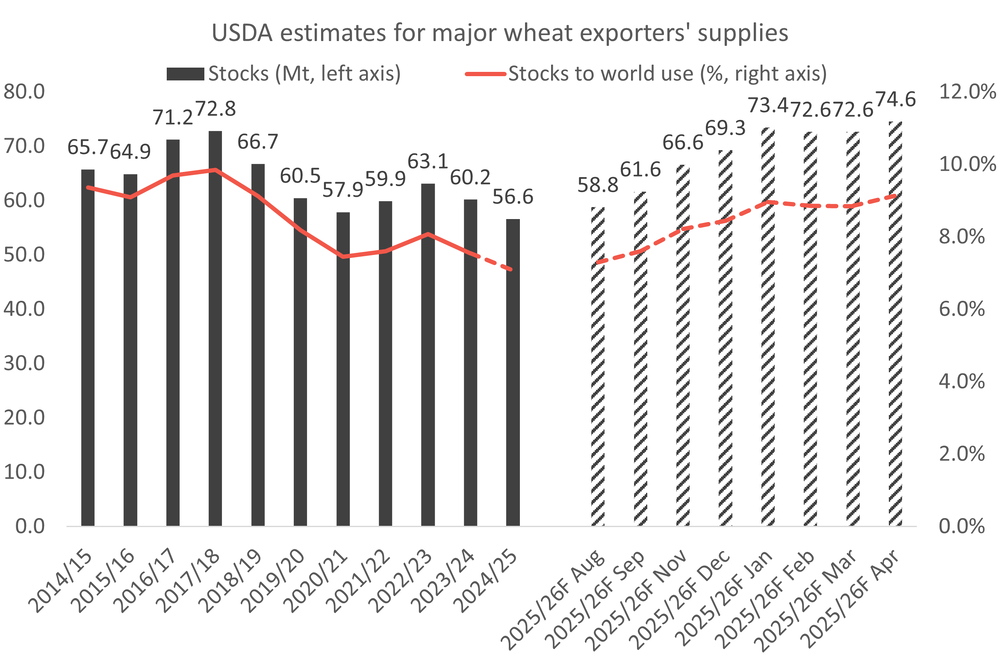
One particularly important consideration is that of ample stocks, a theme enhanced by last week’s USDA April Wasde report. This benchmark briefing, unexpectedly, lifted forecasts for Argentine, Australian, EU and Ukrainian stocks at the close of 2025/26 – raising the overall inventory estimate for major exporters by 1.9Mt to 74.6Mt.


That represented the biggest stockpile in 16 years, and the most comfortable supply in eight years when compared with world demand.


The upgrade reflected not only improved ideas on 2025/26 production (notably in the major exporters) but expectations for consumption, including in the Middle East. This underlines a key difference for the wheat market between the implications of the Iran war, which threatens demand, and the Ukraine war, which put supply at risk.


As the USDA put it, “ending stocks are expanding globally, resulting in an oversupplied market heading into 2026/27”.


USwheatarea 16.04.26

What a contrast to the outlook last summer, before record yields in the likes of Argentina, Australia, Canada, the EU and Russia were confirmed, when the USDA forecast wheat exporters’ stocks shrinking to a five-year low in tonnage terms, and to the tightest in 18 years versus world demand.


Still, for the market now, the odds of that “oversupply” continuing through 2026/27 will become increasingly influential on prices.


These prospects will come into particular focus next month, when the USDA, whose estimates are particularly closely followed, unveils its first full forecasts for global grain 2026/27 balance sheets.


For next season a tightening in supplies is looking increasingly likely.


Sure, yield prospects in the likes of Europe and Russia look strong so far. However, in Ukraine, frost damage has raised a question over prospects, while drought has taken another record US yield off the cards.


Besides, whatever weather may have in store, production looks certain to take a hit from a dip in area, dented by soft prices. Already EU, Russian and Ukrainian winter sowings are estimated down modestly year on year, while the US pegged its all-wheat plantings at the lowest since World War I.


For northern hemisphere spring plantings, and southern hemisphere winter ones, the disincentive to growers from weak prices has only been enhanced by the surge in fertiliser values prompted by the Iran war.


In Australia, where a fuel shortage is hitting particularly hard too, many local forecasters see wheat area slumping below 11Mha, from 12.4Mha last year. This when a looming El Nino hikes the risk of drought ahead.


Wheatexportprices 16.04.26

That is not to forecast a 2026/27 supply squeeze, particularly when rainfall has improved output prospects for some importing regions, notably North Africa. However, there is risk of a tightening in stocks, potentially larger than the 12.4Mt, to 157.9Mt, that the International Grain Council foresees for the top exporters.


Certainly, there is an improved case for risk premium, as is being witnessed in the US prices. There, the premium of Minneapolis spring wheat to Chicago soft red winter wheat has hit $0.50/Bu for the first time since January, spot basis, encouraging extra sowings.


The premium of hard red winter wheat, as grown in the drought-tested US Plains, has near-doubled this month to one-year highs.


Sure, these premiums are still modest by historical standards. But they do illustrate a market confronting supply complacency, a trend that might catch on depending on how sowings and weather progress.


The risk of short-term selling pressure remains, particularly if de-escalation in the Iran war prompts funds to resume shorting wheat.


However, the scope for sustained downside has reduced. The seasonal recovery in Argentine export prices, which have been an anchor on the market, only emphasises that trend.


Related Content

Grain Outlook Video - Geopolitics & Grain - 'The blockade has been blockaded'

Grain Outlook Video - Geopolitics & Grain - 'The blockade has been blockaded'

Weekly Grains Outlook

Weekly Grains Outlook

Analysis of April USDA WASDE

Analysis of April USDA WASDE

Daily Market News

A daily summary of key analysis, prices and factors driving markets
Need to ask an analyst?

Need to ask an analyst?

Related Content

Weekly Grains Outlook

Weekly Grains Outlook

Weekly Grains Outlook

Weekly Grains Outlook

Weekly Grains Outlook

Weekly Grains Outlook