ao link

Weekly Oilseeds Outlook - USDA's key May Wasde report previewed

In a few hours’ time, the USDA will issue one of its most important ag reports of the year, in its May Wasde briefing.


The May edition of the flagship monthly report series is the first to include balance sheets for the new season.


As to what the Wasde will show for rapeseed and soybeans, CRM below issues details of current thinking based on a Reuters poll of traders, and our analysis of market forecasts.


Rapeseed opinion
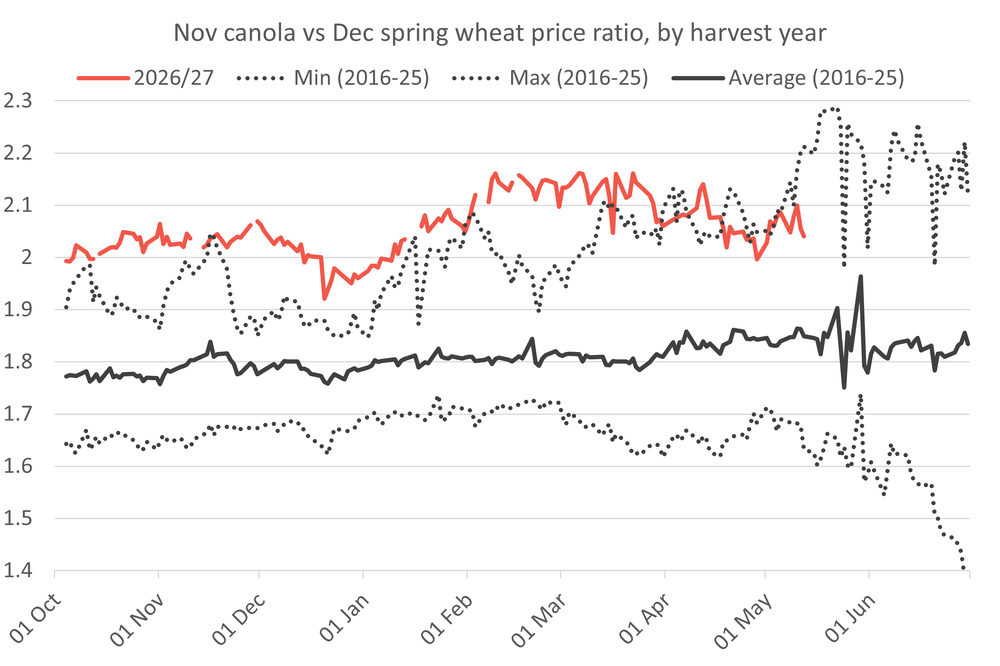
Canolavsspringwheat 12.05.26

Rapeseed does not feature in pre-Wasde trader polling, so there is no obvious indication of what the market expects from the USDA report.


However, for Canada, the top exporter, the USDA often takes a lead from Canada’s ag ministry, AAFC, which foresees a small rise in the country’s canola sowings this year, of 100Kha to 8.8Mha.


Production, however, is forecast by AAFC shrinking by 1.6Mt to 19.2Mt, on a return to a trend yield of 2.19t/ha from last year’s bumper 2.51t/ha result.


This will feed through into a 60% drawdown in the country’s canola stocks to 1.1Mt, a 14-year low, on AAFC forecasts, given buoyant demand in the export market, now that China is buying Canadian origin again, and domestically, with the US purchasing significant quantities of canola oil from its northern neighbour.


That said, AAFC has a history, in its monthly forecasts, of occasional lowball canola stocks estimates which turn out well below levels finally recorded.


The USDA attache in Ontario pegs 2026/27 carryout stocks holding at 2.6Mt, reflecting a higher output forecast, of 20.1Mt, but lower demand figures.


Expectations of a higher output figure have been stoked by a relatively elevated price of canola versus spring wheat, stoking talk of farmers planting more of the oilseed than AAFC has pencilled in.


The unusually slow start to Prairies sowings, thanks to cold weather, is unlikely to be factored in to estimates at this stage.


In the EU, the top rapeseed importer, expectations for production remain at about 20-21Mt, in line with last year’s result.


Should this year’s harvest meet forecasts, it would be the first time in more than a decade that the EU had achieved two crops above 20.0Mt.


Nonetheless, initial expectations for the bloc’s 2026/27 imports stand at about 6Mt, close to estimates for this season’s level, providing volumes needed to support some growth in the crush.


Recent rains in western Europe have bolstered hopes for this year’s harvest, although cold weather even into flowering is viewed as having curtailed yield potential.


WAcanolaarea 12.05.26

For Ukraine, the forecast by the USDA’s Kiev attache of a 4.0Mt rapeseed crop this year is at the top of the range of market expectations.


The USDA may well go with a number closer to the market consensus of roughly 3.5Mt, although there has been some market talk of high oil prices encouraging (unusual) spring sowings, which could lift the figure.


The Ukraine rapeseed export figure will be closely watched too, given that this is the default source for EU imports early season, with knock-on implications for European prices.


Expansion in Ukraine’s own crush capacity has helped limit shipments to 1.6Mt for 2025/26 up to March, a 45% dive year on year.


The USDA’s Ukraine export figure for 2026/27 will be a key number of watch later on.


In the southern hemisphere, forecasts for Australia’s 2026/27 production have centred around the USDA attache’s number of 6.2Mt, down from 7.7Mt last time, reflecting ideas of a 200Kha dip in seedings, as well as a weaker yield number.


However, ideas of strong sowings in Western Australia, the top producing state, have provided upside risk to 2026 output estimates.


According to industry group Giwa, “the early sowing opportunity for canola has driven renewed confidence as it is the most profitable crop grown in Western Australia, particularly when it emerges before mid-May, which will be the case for most crops this year.


“Canola hectares in 2026 will be the largest area planted on record and have increased from 15.5% of the total cropped area over the last ten years to a projected 24.5% this year,” Giwa said, pegging Western Australia canola sowings alone at 2.28Mha.


Although the looming El Nino, with its history of causing drought in eastern Australia, represents a foreseeable yield threat, the USDA is likely to wait until dryness is evident before factoring it into forecasts.


Soybeans


USsoybeanproduction 12.05.26

The US soybean harvest is expected in Wasde to come in at 4.44 billion bushels, equivalent to 120.9Mt, according to a Reuters poll.


That would be close to the 121.1Mt that the USDA forecast at its Outlook Forum in February, and represent the country’s second largest soybean harvest on record behind only the 121.5Mt achieved in 2021.


The report is expected to peg US soybean stocks at the close of 2026/27 at 9.6Mt, close to the USDA’s Outlook Forum estimate, and indeed near the 9.5Mt currently forecast for this season.


An unusually rapid pace of spring sowings so far has supported prospects for a strong harvest this year, as has the incentive to plant soybeans provided by its low nutrient needs, at a time of high fertiliser prices.


However, it is early to be factoring such factors into forecasts. The USDA will give updated area estimates at the end of next month.


For Brazil, which is only just winding up its 2025/26 soybean harvest, sowings of the 2026/27 crop are still four months from starting in the key centre-south growing belt.


However, market consensus, as assessed by CRM Agri, is of a crop of 183-184Mt, up from the record 180Mt or so expected this season.


Output is seen as being supported by a continuation of a trend of increased sowings, as extra land is brought into arable production.


Soybeans’ lower nutrient needs are viewed as holding particular sway in 2026/27 in South America, a big fertiliser importing region, where farmers are believed to hold little cover yet for next season.


Similarly, Argentina is currently seen as likely to witness some recovery in soybean sowings, after a sharp decline in 2025/26 when farmers returned to corn, with the retreat in incidence of the chicharrita insect pest.


Market ideas are of a crop of about 49Mt, up some 1Mt year on year, although remaining below th 51Mt achieved in 2024/25.

Related Content

Weekly Grains Outlook - 'Let the oil flow'

Weekly Grains Outlook - 'Let the oil flow'

Weekly Oilseeds Outlook

Weekly Oilseeds Outlook

Global Crop Watch - Brazil's safrinha harvest weighs on corn market

Global Crop Watch - Brazil's safrinha harvest weighs on corn market

Ukraine 2026/27 crop estimates

Ukraine 2026/27 crop estimates

Need to ask an analyst?

Need to ask an analyst?

Daily Market News

A daily summary of key analysis, prices and factors driving markets
Need to ask an analyst?

Need to ask an analyst?