| Bullish factors | Bearish factors |
|
|
Rapeseed opinion
📉 Sentiment Indication: Rapeseed prices continue to be influenced by the extent of Middle East tensions, and their impact on prices of oil, which in turn impacts demand potential for biodiesel.
A disappointing pace of imports of Australian canola is helping support European prices. However, large exporter stocks overall, and a promising supply outlook so far for 2026/27, suggest scope for pressure on prices should crops perform this season.
As previously mentioned, rapeseed prices are trading near the top of their long-term trend, suggesting that, without a fresh catalyst, the extent of price recoveries will remain limited.
Market update
Rapeseed futures have, in retreating this week in Paris from 14-month highs, displayed their vulnerability to crude oil.
Brent crude futures for July-26 have tumbled by some 13% from their early-week highs, undermined by reports that Washington believes it is close to a framework deal with Tehran to end the Iran war.
That undermines prospects for prices of biofuels, in turn suggesting pressure on prices of vegetable oils such as rapeoil, weighing on values of oilseeds themselves.
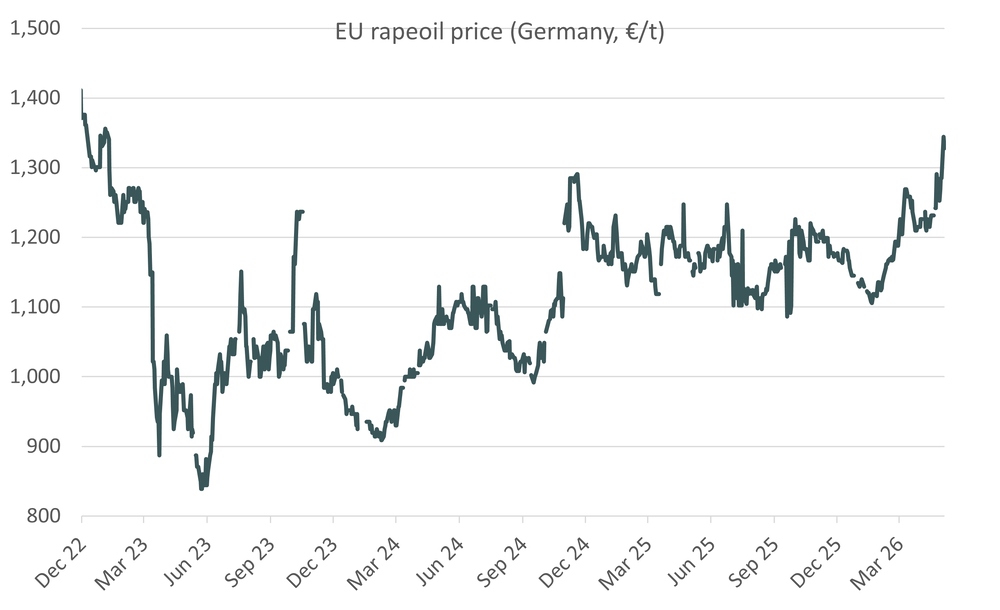
Rapeoil values have scope for declining too, having risen by 12% since the start of the Iran war to exceed €1,300/t in Germany for the first time in three years.
Nonetheless, there is more than the short-term course of the conflict, and crude oil, in play.
Vegetable oil prices were already finding support from geopolitics, even ahead of the 28 February Israeli-US attacks on Iran, through moves in many countries to enhance biofuel mandates.
This was most notable in the US, where regulatory boosts to biodiesel demand have stoked a surge in Chicago soyoil prices to their highest since late 2022.
However, the likes of Brazil, the EU, Indonesia and Malaysia were shifting towards encouraging biodiesel too – a trend which has only gained momentum from the war, and its exposure of the fragility of fossil fuel supply chains.
After all, the Middle East and Russia, another country involved in conflict, are responsible for more than 40% of world oil exports, on 2024 values.
As Heather Jones, a veteran agribusiness analyst, put it on Tuesday: “Biofuel policy, not just in the US, but globally, is the most constructive it’s ever been.”
Although a dip in oil prices undermines vegoil demand potential, the Iran and Ukraine conflicts will leave a long tail in terms of political support for biofuels.
That is not to say that the shorter-term case for rapeseed prices is all supportive.
The pace of EU imports is picking up a bit. Revised data for the third week of April show imports actually hitting 246.4Kt, well above the 95.4Kt initially reported, and making it second largest week of the season.
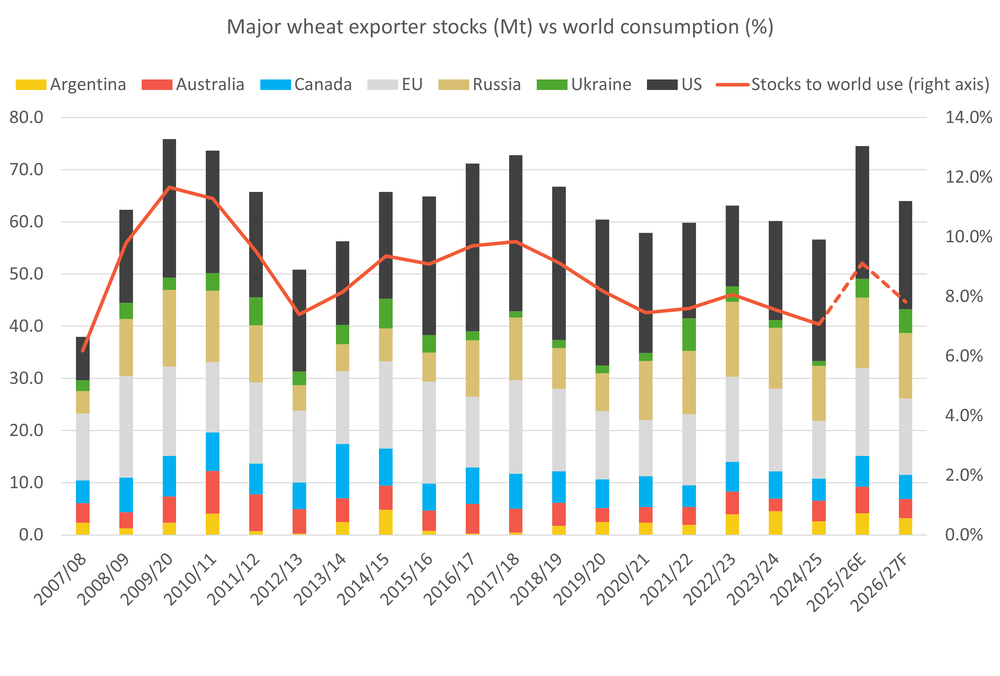
EU imports from both Australia and Canada have doubled over the past two months, to 1.3Mt and 803.0Kt respectively. Even so, major exporter stocks are forecast to end the season at their loosest in six years.
Turning to 2026, hopes for EU output remain high too, at 20-21Mt, buoyed by recent rainfall in western countries, if with dryness in the east still of concern.
That said, ideas of a strong Canadian crop – boosted by relatively high prices, and low production costs, versus spring wheat – are being tested by dry and cool weather which is hampering the start of the Prairies sowings campaign.
The looming El Nino, with its history of bringing dryness to eastern Australia, poses a threat to Australia’s 2026/27 output too.
Certainly, the rapeseed market may face selling, assuming Iran war de-escalation, and a pressure on oil prices. However, price downside is more limited than it was before the conflict, even as values around €540-550/t, and the top end of the three-year trading range may present resistance to upside moves, and short-term sell-offs.
Soybean opinion
📉 Sentiment Indication: Soybean prices have moved somewhat independent of oil prices, even in the aftermath of the Iran ceasefire deal, with Chinese imports and US biofuel policy also big influences.
Strong US crush demand, backed by the boost to soyoil prices from biodiesel hopes, has helped offset pressure from a sluggish US export performance.
A lower-than-expected USDA forecast for US soybean sowings this year, and a release of seasonal pressure from Brazil’s harvest, has offered support as well, although a huge fund net long in the complex presents downside price risk.
Market update
For soybeans, price pressure prompted by retreat in crude oil prices on hopes of Iran-US de-escalation has been relatively mild.
Chicago futures for July-26 remain above the $11-60-12.00/Bu trading range which constrained them from mid-March until this month.
That is not just because of the relative resilience to crude oil’s decline of soyoil prices, which have back-up support of increased biodiesel mandates, as discussed above.
As ADM chief executive Juan Luciano put it, in the US, the stimulus to recent soybean crush rates from improved biodiesel rules had “probably… happened with more violence than we expected”.
“It was faster, maybe because of pent-up demand” from an industry which had been awaiting fresh US biodiesel blending rules “for a couple of years”.
“We continue to expect a constructive biofuel environment going forward,” he added.
Also limiting downside to soybean prices are hopes that China will issue a fresh swathe of import orders for US soybeans, now that a date, of May 14-15, has been put on the summit between US President Donald Trump and his Chinese counterpart Xi Jinping.
Such custom is viewed as providing a positive backdrop to the talks, reheating thinking which spurred a surge in soybean futures from early February to mid-March, ahead of the initial date scheduled for Mr Trump’s visit to China.
Indeed, it is notable that the latest jump in soybean prices has fallen short of the rally then, which peaked above $12.50/Bu, July-26 basis.
But then, scope for fund buying looks less significant this time. Managed money has already used much of its powder in holding its net long position in Chicago soybean futures at a sizeable 176.9K contracts as of 28 April.
Funds started the February-March soybean rally with a net long of less than 30K contracts, which they expanded to 211.5K contracts over the following five weeks.
In fact, funds’ net position in the soy complex as a whole, ie including soyoil and soymeal, remains near a record high, at 462.3K contracts.
That does pose substantial downside risk, should soy markets face a stiffer headwind which persuades managed money to sell up in a hurry.
What could pressure prices?
One potential cause of market setback could be a failure of China to buy big on US soybeans. The US’s export record to other destinations is poor. It is struggling to meet the pace needed to meet even the 13-year low of 41.9Mt that the USDA forecasts for 2025/26.
Export prices which have rebuilt a premium to rival origins – the gap between US Gulf and Paranagua, Brazil values has returned above $30/t – hardly suggest a change in fortunes.
Another might be a switch by farmers to extra soybean sowings, versus corn, an outcome which could be encouraged by high prices of fertiliser, for which soybeans are far less hungry, given their ability to switch nitrogen from the atmosphere.
Nor are prices encouraging farmers to prefer the grain over the oilseed. The ratio of new crop November-26 soybean futures for December-26 corn ones stands at an average level of 2.39.
CRM Agri continues to believe that ultimately greater price risk lies to the downside, although of course geopolitics poses considerable potential for prices moves should tensions escalate once again.