• French maize plantings unusually fast
• Turn wetter in French weather bodes well for establishment
• Oklahoma crop tour reveals sharply lower wheat yields
• Gives indication on prospects for US harvest
The cold which has spurred further deterioration in US Plains winter wheat is hampering farmers north of the border too.
Cool weather, marked by late snows, has hampered the start of the important Prairies spring planting season.
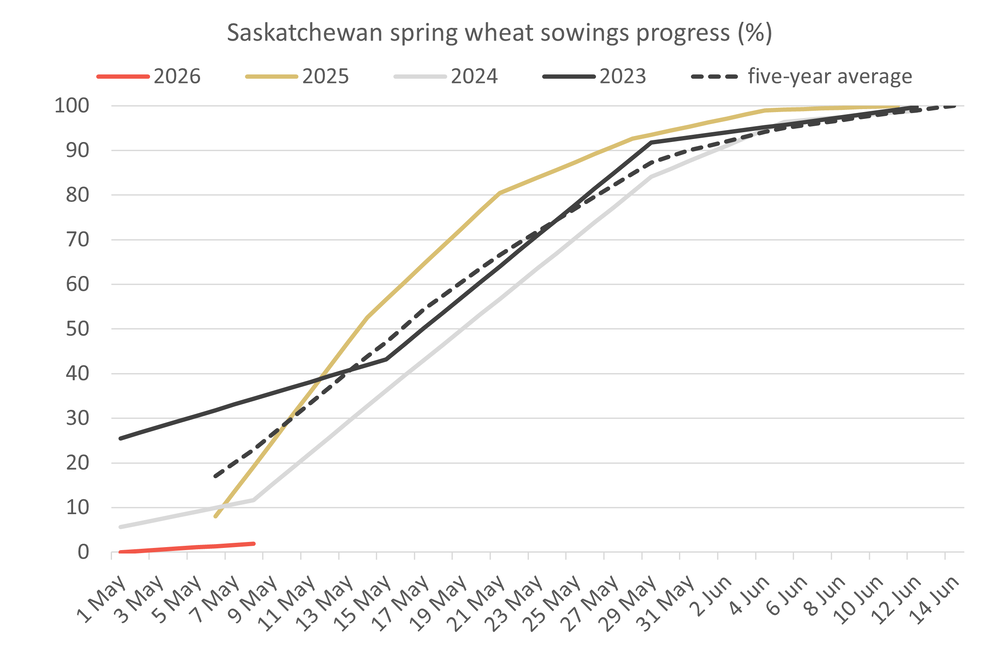
Planting of spring wheat, of which Canada is the top producer and exporter, was only 1.9% complete in Saskatchewan, the top growing province, as of 6 May. That is the slowest rate of progress in 12 years, and well behind the five-year average of 17.0% by then.
For canola, of which Canada is also the top shipper, Saskatchewan seedings were 3.3% complete, also the slowest since 2014, and behind a five-year average of 9.9% for 6 May.
West in Alberta, sowings have been slow too, reaching 8.3% complete for all crops as of 5 May, versus a five-year average of 15.3%
The 0.8% of Alberta canola sowings finished compares with a five-year average for that date of 3.9%.
The sluggish progress reflects what Alberta ag officials termed “unseasonably cool and snowy” weather.
“Persistent cool conditions resulted in a later start to seeding across the province.”
Saskatchewan’s ag department said that “cold temperatures, frozen soils and washed-out roads are limiting seeding progress for many areas”.
Still, market sources report that the conditions are not, yet, causing undue market concern.
One reassurance is that there is little correlation between early sowings progress and final production, for canola or spring wheat, to judge by Saskatchewan data going back to 2014.
Another is that the snowy conditions have bolstered soil moisture too, limiting drought to far southern parts of Alberta and Saskatchewan.
“The additional moisture was welcome,” Alberta officials said. Saskatchewan reported only 7% of its cropland as short of moisture, with 69% having adequate levels and 24% a surplus.
Nonetheless, future sowings progress will be monitored.
“Markets will begin to start taking note of this if it does get too late,” a source said, adding that the sluggish progress was “something to keep note of going forwards”.