Weekly Oilseeds Outlook
| Bullish factors | Bearish factors |
|
|
Rapeseed opinion
📉 Sentiment Indication: Rapeseed prices attracted pressure on the announcement of an Iran-US ceasefire, as improved prospects for oil and gas supplies eroded demand potential for biodiesel, as made from vegetable oils.
Large exporter stocks, and a promising supply outlook so far for 2026/27, suggest pressure on prices ahead.
With the geopolitics still uncertain, scope for volatility remains. However as mentioned over recent weeks, rapeseed prices are trading at the top of their long-term trend, therefore the current sell-off is in line with expectations.
Market update
Rapeseed prices lost buoyancy in the aftermath of Tuesday’s news of a two-week Iran-US ceasefire.
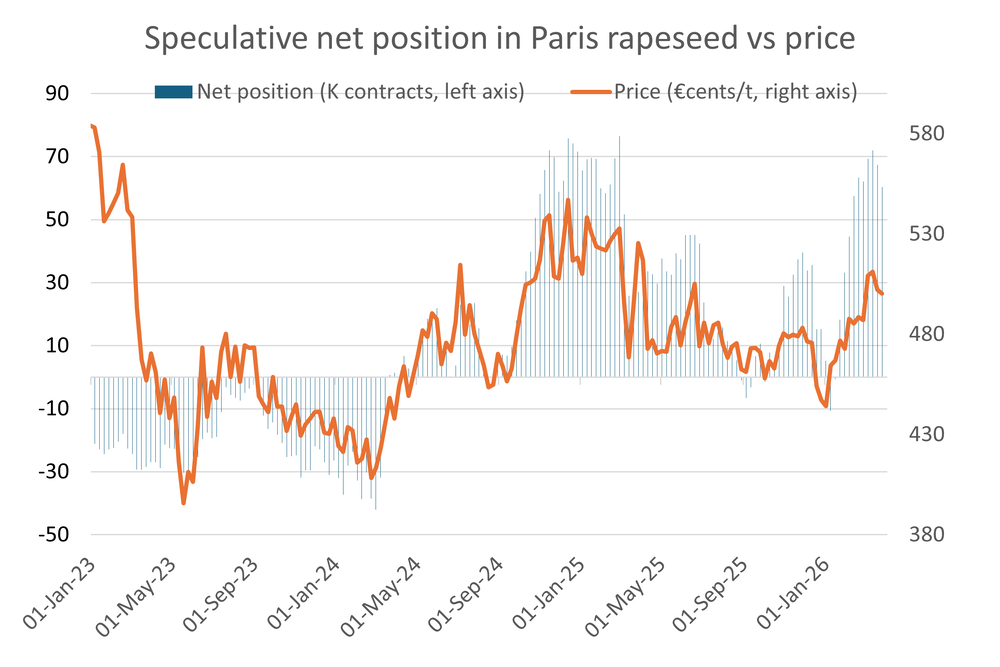
The Paris May-26 contract retreated below €500/t, before finding support at its 50-day moving average, which it had not come close to since January.
But then the oilseed is - with its high content of vegetable oil, as used largely in making biodiesel - exposed to the energy markets which took a tumble on the prospect of the freeing up of the Strait of Hormuz. (The initial reaction of Chicago May-26 soyoil futures was a 5.0% dive.)
The potential for Iran peace also erodes concerns over broader Middle East conflict which could disrupt Europe’s imports of Australian canola, which are amid their seasonal peak.
Funds had Paris rapeseed contracts to sell too, having lifted their net long position (ie the extent to which long bets, which profit when prices rise, exceed short holdings, which benefit when values fall) to unusually high levels above 60K contracts.
Of course, there is the chance yet that the conflict will resume, or that Iran will return to hampering shipping through the Strait of Hormuz.
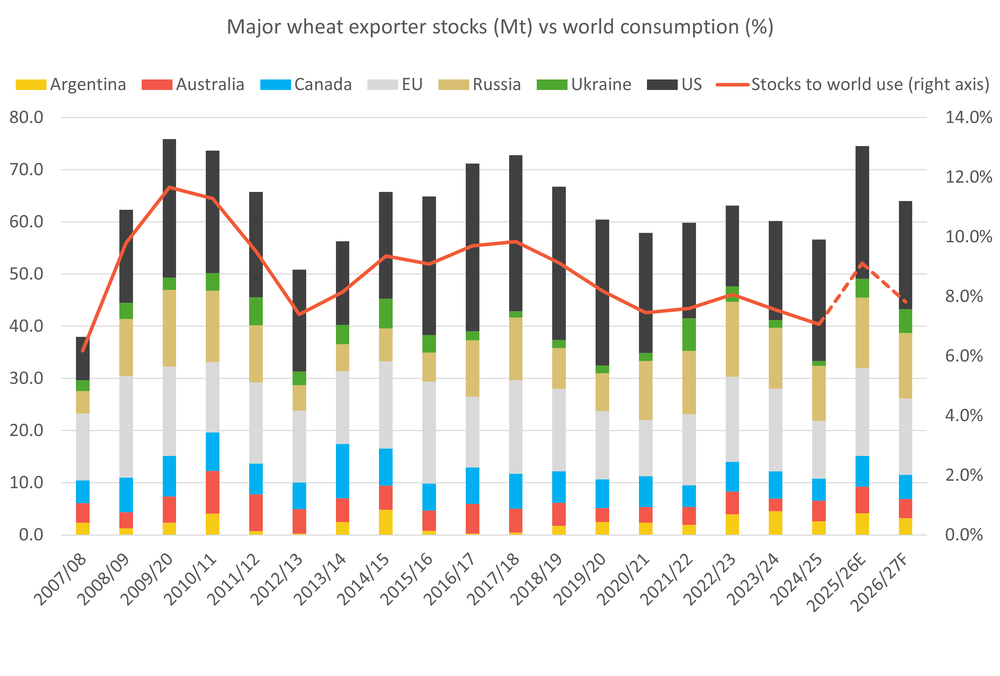
Nonetheless, the ceasefire renews market focus on fundamentals which, for rapeseed, do not appear as supportive as Paris prices close to €500/t would suggest. Not only are major exporter stocks forecast to more than double in 2025/26, to a seven-year high of 4.3Mt, and EU ones hold at a 13-year high of 2.2Mt, but prospects for 2026 production are reasonably promising - so far.
Europe’s winter crop has made a decent start, while Ukraine’s 2026 harvest is seen improving a little on last season’s 3.6Mt. Canada’s canola sowings are broadly expected to exceed the official forecast of 8.8Mha, backed by unusually high prices versus spring wheat, a key rival for area.
Australia’s 2026 plantings are foreseen expanding by 50-100Kha too, although the potential of an imminent El Nino, which has a habit of bringing drought to the country, does raise the threat of production losses.
Furthermore, Europe’s 2026/27 overall oilseed production may be supported by expanded sowings of sunflowers, which many farmers are reported to be considering as a lower-cost alternative to corn for spring sowings, at a time of high fertiliser and fuel prices.
In the French cash market, sunseed’s premium to rapeseed has shrunk by more than 25% over the past fortnight, to €115/t.
The seasonal acceleration in Europe’s imports from Australia adds to the case, from fundamentals, for downside potential for EU rapeseed prices, although the scope for continued geopolitical risk remains the main wildcard for oilseeds markets.
Soybean opinion
📉 Sentiment Indication: Soybean prices have continued to move somewhat independent of oil prices, even in the aftermath of the Iran ceasefire deal, with Chinese imports and US biofuel policy also big influences.
Strong US crush demand, backed by the boost to soyoil prices from biodiesel hopes, has helped offset pressure from a sluggish US export performance.
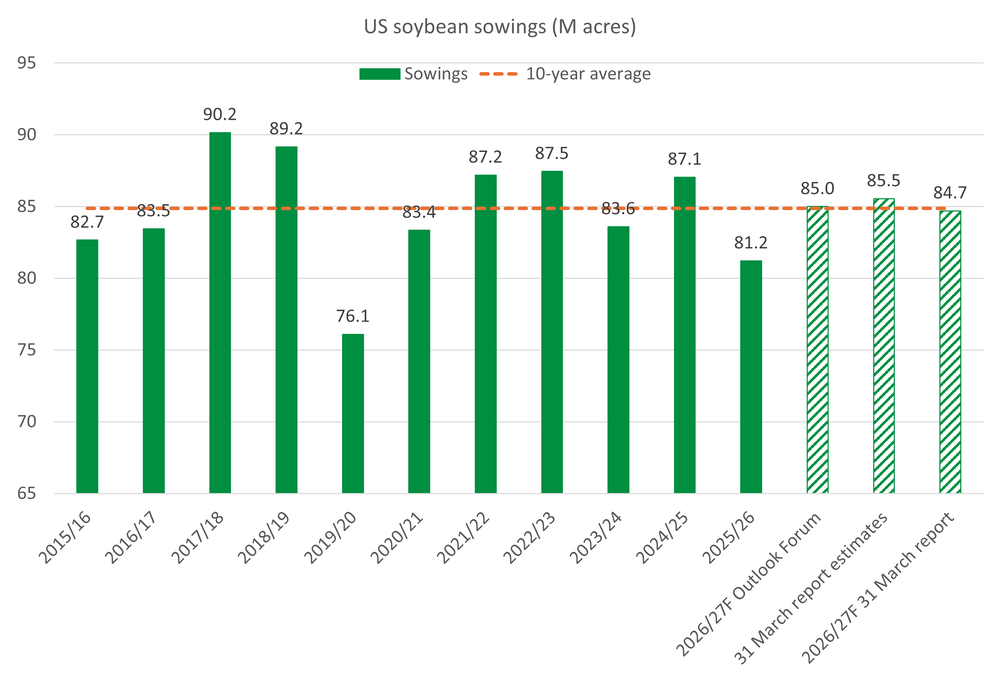
A lower-than-expected USDA forecast for US soybean sowings this year, and a release of seasonal pressure from Brazil’s harvest, has offered support as well.
Market update
Soybean futures are proving hard to dislodge from their four-week trading ranges.
The May-26 contract held comfortably last week within its $11.50-11.80/Bu trading range (and the July-26 lot within its $11.60-11.95/Bu corridor) even after the USDA forecast that US farmers would sow, at 84.7M acres, some 850M acres fewer with soybeans than the market had expected.
That is equivalent to more than 1.2Mt of lost production, using the 2026 abandonment and yield forecasts the USDA unveiled at February’s Outlook Forum.
This week, the market was only temporarily unsettled (at least, to judge by early deals) by a negative price surprise, in the Iran war ceasefire.
The May-26 contract, after initially tumbling by 1.5%, recovered to show marginal gains even as many other commodities struggled, losing some of the investor favour gained from being viewed as hedges against reviving inflationary pressures. The Bcom commodities index stood 4.6% lower at that time, and the S&P GSCI down 9.0%.
But then, as CRM Agri has been highlighting, the Iran war has not been alone in calling the tune in the soybean market.
The market has also kept a keen eye on the state of Beijing-Washington relations, and whether China will indeed return for another helping of US soybean imports. Mr Trump’s rescheduled visit to Beijing next month – viewed as catalyst for a fresh batch of Chinese orders of US soybeans - looks less vulnerable to another postponement if Middle East conflict does not re-escalate.
Another key political support to soybeans, from the boost to potential soyoil use from an enhanced US biodiesel mandate, has met market approval too.
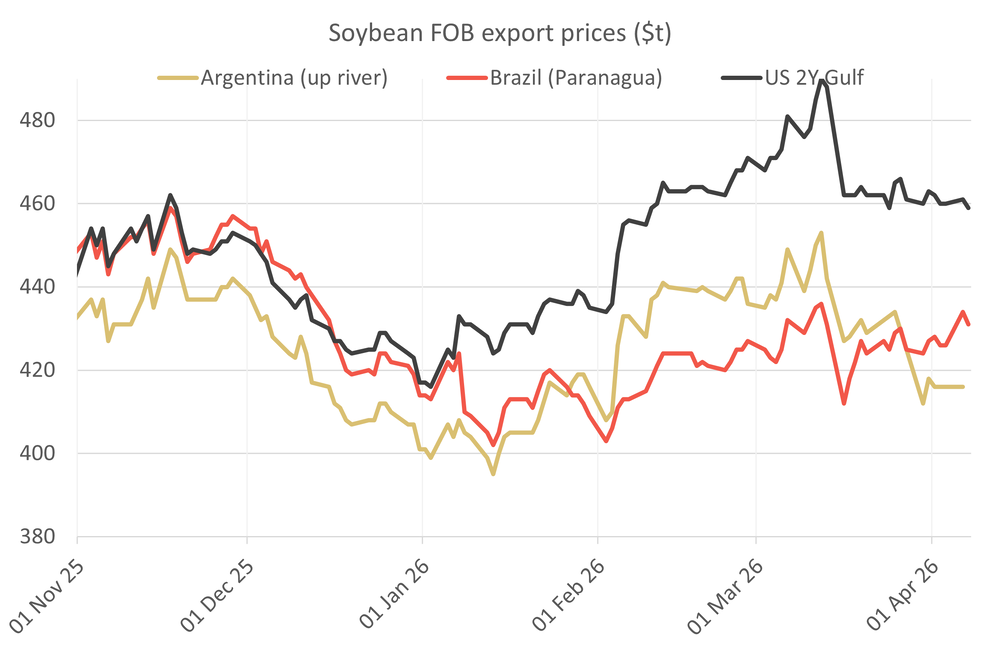
Meanwhile, fundamental drivers remain, including a release of pressure from Brazil’s harvest as it has passed 80% completion. Prices in the top growing state of Mato Grosso rose by 2.3% in the week to Monday, to a 2026 high of $335/t.
At the port of Paranagua, prices gained 2.4% over the same period to narrow their discount to US Gulf values to a two-month low.
With Paranagua prices nonetheless still $27/t cheaper, that does not back the case for a Chicago rally.
However, it does help explain why Chicago values proved initially relatively invulnerable to the oil price decline, despite exposure via soyoil to energy markets.
Still, the progress of Iran peace negotiations will remain a key focus for soybeans, both in terms of broader market influence and factors such as the influence on fertiliser prices. High nutrient values tend to favour sowings of the oilseed which, in being able to fix nitrogen from the atmosphere, is relatively cheap to grow.
With the potential for fresh Chinese purchases of US soybeans too, the scope for price support remains. However a sell-off by funds will continue to add pressure in the short term, so long as the ceasefire and peace talks are not derailed.