El Nino expected begin in during the May-to-July period
With input prices high too, spurring talk of big dip in wheat, canola area
Australia’s winter grains sowings campaign, by repute, kicks off on Anzac Day, 25 April.
However, prospects for the plantings window are being particularly closely watched this year because of tests from soaring costs of inputs, and the expected El Nino - a weather pattern which has a habit of bringing dryness to eastern Australia and many growing areas of Western Australia too.
The chance of El Nino bedding in during the May-July period is 72%, according to official US meteorologists, who see it lasting until at least early 2027.
This will take the El Nino through most of the 2026/27 growing period for Australian winter grains, and into the growing period for summer crops such as sorghum too.
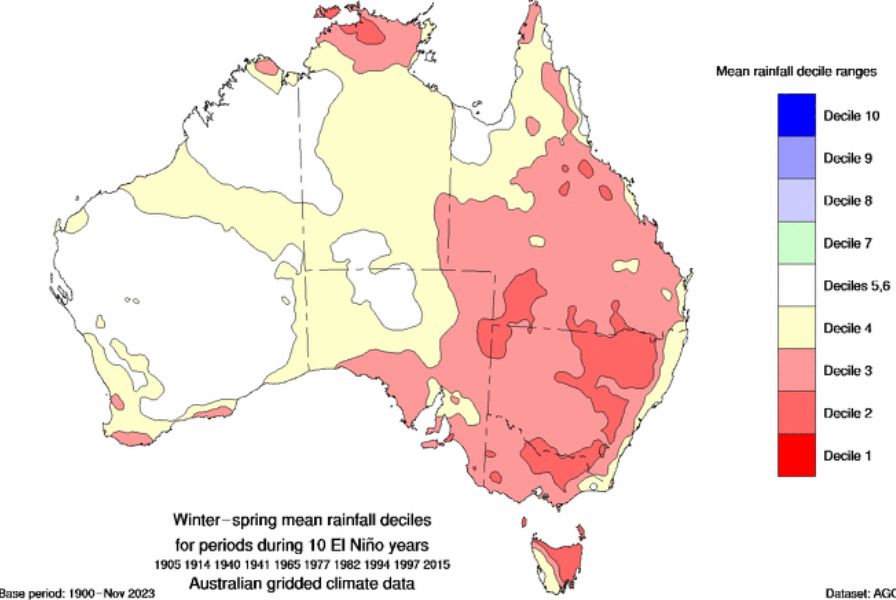
The threat of a "big dry" posed by the weather pattern is underlined by Australia’s Bureau of Meteorology, which says that nine of eastern Australia’s 10 driest winter-spring periods occurred during El Nino years.
"In the Murray-Darling Basin, winter-spring rainfall averaged over all El Nino events since 1900 was 28% lower than the long-term average, with the severe droughts of 1982, 1994, 2002, 2006 and 2015 all associated with El Nino."
Temperatures tend towards extremes too, thanks to decreased cloud cover.
"El Nino years tend to see warmer-than-average temperatures across most of southern Australia, particularly during the second half of the year," the bureau said, although adding that the threat of night-time frost is enhanced too.
"Regions of southern New South Wales and northern Victoria can experience 15-30% more frost days during El Nino than the historical average."
The threat of weather setbacks, combined with the increased input costs, is provoking talk of marked declines in Australian sowings of some crops, notably canola and wheat, in favour of alternatives such as barley which are more drought resistant besides having lower nutrient needs.
Some sources are forecasting a slump in wheat sowings below 11Mha, from 12.4Mha last year.
The El Nino penalty can, after all, be severe, as recent history shows. The Australian wheat yield hit a record 2.61t/ha in 2016/17, which was marked by a La Nina, bringing eastern Australia plentiful rain. However, that slumped to 1.69t/ha in 2018/19, and 1.47t/ha in 2019/20, both seasons marked by El Ninos.
Production went from 31.8Mt to 17.6Mt in 2018/19 and 14.5Mt the following year.
For canola, output tumbled from a record 4.3Mt in 2016/17 to 2.4Mt in 2018/19 and 2.3Mt in 2019/20.