• US market reassured by USDA’s 2026 sowings forecast
• However, high fertiliser prices test area assumptions
• Uncertainty over Argentine, Brazilian harvest results
• EU prices widen premium, as stocks dwindle
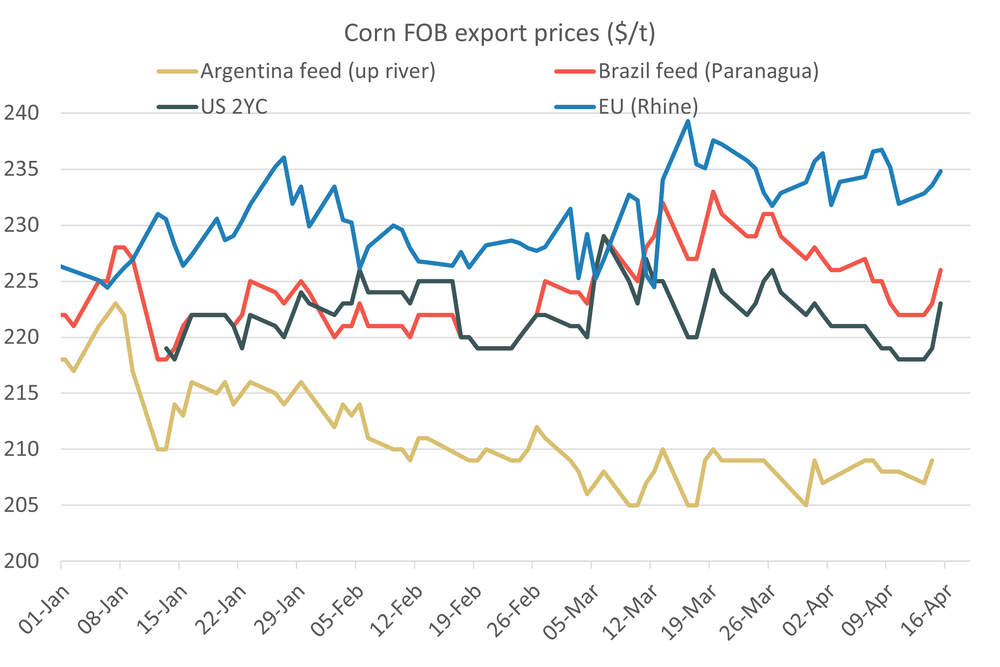

Corn prices have, after rallying in the initial stages of the Iran war, lost their way – albeit moreso in Chicago than Europe, where supply dynamics remain tighter.
The broader corn market is under pressure in part from an Argentine harvest which, nearly one-quarter of the way through, looks like being a large one – although just how large is a matter of unusual disagreement.
The USDA in its Wasde briefing restated a forecast of a substantial 52.0Mt crop – 5Mt above the 10-year average, although remaining 3.5Mt below 2020’s record high. This hours before the Buenos Aires grains exchange pegged production at a huge 57.0Mt.
However, both of these figures were leagues short of the Rosario grains exchange’s estimate, the previous day, of a whopping 67.0Mt harvest.
As to which local analysts (all of which agree on a 2024/25 crop of about 50Mt) are right, the extent of Argentina’s harvest, which stretches until September, offers plenty of scope for surprises.
Nonetheless, the export market hasn’t waited for details. Argentine corn prices have dipped in a quest for exports, weighing on Brazilian and US offers too.

A second supply comfort came on 31 March when the USDA pegged 2026 US corn sowings at 95.4M acres - 1.4M acres above its previous estimate, and 1.0M acres above market expectations.
Signally, the figure was based on a survey conducted in the first half of March, so made some allowance for the Iran war’s boost to prices of fertiliser, for which corn is particularly needy.
Although nitrogen, and fuel, prices have risen further since, further raising production costs, the Chicago corn prices appear relaxed over supplies. Corn futures have doubled above $1.40/Bu, spot basis, their discount to wheat since the start of the year, and lagged soybeans in the annual US “battle for acres” too.
The ratio of new crop November-26 soybean futures to December-26 corn ones stands slightly above seasonal average of 2.40. So, it is not offering farmers any extra price incentive to choose the corn over soybeans, despite the oilseed’s lower growing costs.
Still, there is scope yet for the reinjection of risk premium.
The continued gain in fertiliser prices is provoking debate about just how well covered US farmers really are for nutrients. US Gulf urea futures for May-26 on Tuesday touched $722/T, up from $403/T before the war.

Meanwhile, weather maps suggest central Brazil’s dry season kicking in a fortnight earlier than usual, eroding hopes of another record safrinha crop, for which harvest starts in June.
Outside the Americas, there is increasing talk of a dent to sowings from high fertiliser prices. Ukraine’s output is expected to fall by some 1Mt this year, to about 30Mt, while French farmers are reportedly considering notable corn sowings reductions.
This even when EU corn prices are displaying supply tightness, in an unusual premium in Paris versus wheat spot basis, and a premium of $60/t versus Chicago corn well above the $45/t average.
It looks like the knock-on effects of a disappointing EU harvest and reduced pace of exports from Ukraine, the default origin for Europe, is biting. The USDA forecasts EU corn stocks ending 2025/26 at a 13-year low of 5.9Mt. And that assumes a generous 19.5Mt import total.
So the outlook for European corn prices remains relatively firm, to stimulate imports for now and sowings for 2026/27.
In Chicago, the decent start to US 2026 sowings backs initial projections of a second successive crop above 400Mt.
However, the potential yet for weather setbacks in the US, or elsewhere, let alone for knock-on impacts of the war to curtail sowings, are both threats to monitor.