Volatile gas prices stall fertiliser prospects in Europe, while the oil market outlook hints at price pressure for biofuel crops
Crude oil opinion
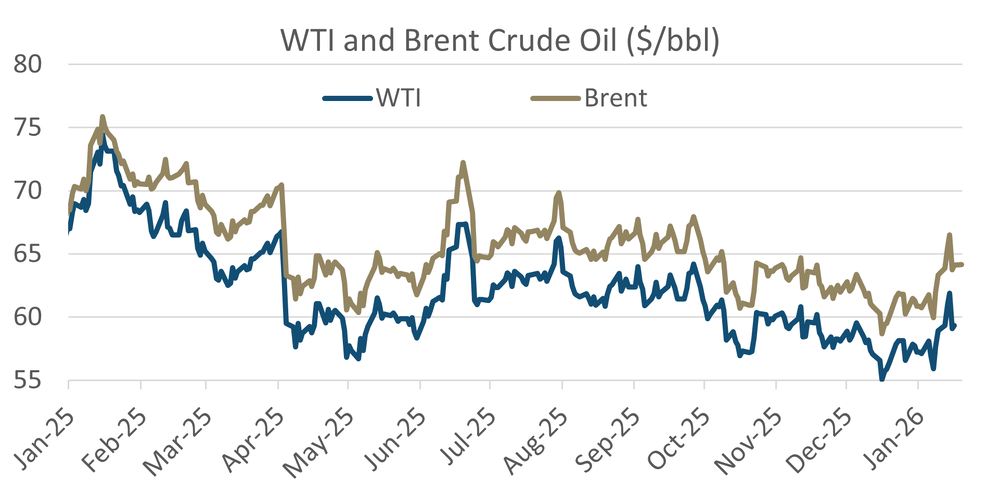
Geopolitics continues to influence short-term price dynamics in global crude oil markets, but has had little influence over the fundamental story—of a growing global oil surplus throughout 2026 due to higher OPEC+ production amid tepid global demand growth. Despite some recent jumps, the downward trend in prices remains.
The US, alongside EU countries, outlined rigorous plans to ensure a lasting ceasefire deal in Ukraine. However, ongoing attacks to key energy infrastructure suggests Russia and Ukraine are still far away from a truce.
Donald Trump’s temporary takeover of Venezuela’s oil sector also pushed global oil prices lower as investors sought to price the impact on global markets should the US revive the South American country’s creaking oil infrastructure.
Chevron, Shell and Repsol pledged $100bn in new investment, but it would take years before production could reach meaningful levels and the news had little impact on prices. In Iran, protests had originally sparked concerns around US intervention and/or the possibility of the closure of the Strait of Hormuz. However, this remains a tail risk, having minimal impact on prices thus far.
The consensus among the top financial institutions is for WTI oil prices to trade around $58/bbl on average, while they expect Brent crude oil prices to average around $60/bbl.
For agricultural markets, this implies crude oil markets creating a headwind for prices in 2026.
With oil trading at near its lowest level since 2021 and the price outlook soft, fuel distributors will be looking to cut petrol prices at the pump to spur demand and avoid inventory builds.
This was starting to weigh in Q4 on values of ethanol, which trades at a discount to gasoline due to its lower energy content. Lower ethanol prices in the US or the EU weigh on blenders’ margins and lead to softer bids for corn and other feedstocks, with knock-on effect for feed crop prices.
However, the recent rise in natural gas prices has support a recovery in ethanol markets. Moreover, ethanol demand is on the rise due to the roll out of E-15 (15% ethanol in petrol) in the US and higher blend mandates in some EU countries, which could offer some support.
Natural gas (EU) opinion
Dutch TTF natural gas prices had since June been on a strong downward trend, but sky-rocketed over the past week to a six-month high.
Although the longer-term outlook is bearish for European natural gas markets, the price volatility in recent years is likely too big of a headache for EU fertiliser producers to bring large production volumes back online any time soon. Moreover, recent EU policy changes are expected to push fertiliser import costs higher, posing a significant threat to growers’ costs.
Last year, the EU Commission loosened its policy that requires EU natural gas inventories to be 90% full by 1 November each year, designed to ensure the bloc has enough supply to last the winter.
Prices continued to drift lower during November as gas suppliers were in no rush to reach the target and eventually reached it by 1 December.
On top of this, speculative funds took the opportunity to open a significant number of short positions Dutch TTF, in anticipation of significant LNG export capacity coming online in 2026 and 2027.
However, a severe cold snap across Europe and parts of Asia, increased heating demand and shrank EU storage levels to 53% of capacity, down significantly from last year, and around levels seen in 2022 when gas prices were at record highs. The cold weather led to a sharp increase in LNG demand and speculative funds rushed to short-cover.
Although markets are not at risk of rising to those levels back in 2022, it highlights the ongoing volatility in EU gas markets and is likely to keep fertiliser producers on the sidelines over the medium term.
Meanwhile, in 2026, the EU implemented two key policies - EU carbon pricing on shipping and the Carbon Border Adjustment Mechanism (CBAM).
The carbon pricing on shipping scheme is expected to raise freight costs into the EU across board, while the CBAM, which targets carbon-intensive industries, will raise the cost of fertiliser imports by embedding the price of carbon emissions into products such as ammonia, urea, and other nitrogen-based fertilisers.
Because these imports often carry higher embedded emissions than EU-produced equivalents, CBAM will make them more expensive, reshaping trade flows and allowing domestic producers to attain a premium.
For agricultural markets, the potential for higher fertiliser prices will weigh on EU growers’ profitability, making them less competitive to other industries.
In the UK, fertiliser imports for now won’t be subject to the CBAM, but the government has plans for a similar tax through the UK Emissions Trading Scheme (UK ETS), which is expected to be rolled out in 2027.
In the EU, France and Italy are lobbying to exclude fertiliser from the list of sectors subject to the tax, but it remains to be seen if their efforts will bear fruit.