Weekly Grains Outlook - Wasde and peace talks mean big week for grains. What will it bring?
| Bullish factors | Bearish factors |
|
|
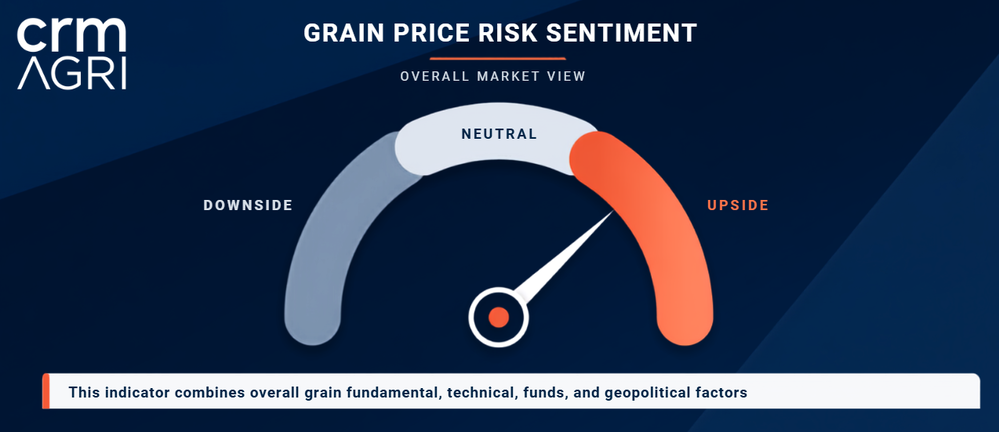
📈 Sentiment indication: Supportive. The Black Sea shipping crisis keeps a marked risk premium in wheat, and smaller Argentine and Australian crops year on year limit the relief the southern hemisphere harvest can offer. For Chicago corn, oversold futures, firmer US export sales and a potential pick-up in Chinese imports point to recovery later in Q4.
Wheat opinion
Wheat markets have, in falling to multi-month lows, factored in considerable hope value on supplies – leaving them primed for recovery should improvements not materialise.
Our view is that - unless exports indeed improve soon - wheat markets are oversold, limiting downside risk and indeed presenting potential for support. Even in the event of a recovery in exports, the back log and infrastructure damage means there remains scope for price support as stocks tighten later in the season.
The prime cause for supply optimism is the prospect, starting on Tuesday, of two days of talks between Russia, Ukraine and the US aimed at bringing an end to the Ukraine war.
There is, on the face of it, a logical case for both Russia and Ukraine to agree at least to hold off attacking each other’s vessels and ports, and bring resolution to the Black Sea shipping crisis. However, the political machinations surrounding the conflict are complex and opaque, as evident in the failure of previous talks to foster de-escalation.
The chances of a ceasefire, let alone a peace deal, do not exceed 50% until May 2027, according to the Polymarket betting site. (The odds of a deal by the end of this year are steady at 15%.)
Even if a safe passage agreement on Black Sea shipments is reached, Russia and Ukraine would be able to recoup only a portion of trade lost so far. There are limits to the capacity of their infrastructure which is, anyway, still be repaired from drone attacks, and with often-prohibitive winter weather to negotiate too.
Sure, the southern hemisphere is giving supply relief too, with supplies from strong Argentine and Australian harvests.
Nonetheless, 2026/27 output will come in well below last year’s bumper levels, by a combined 11.4Mt on current USDA forecasts. (Note: there is scope for the USDA to upgrade both harvests by 500-1.0Mt in Tuesday’s Wasde crop report, to judge by trade estimates.)
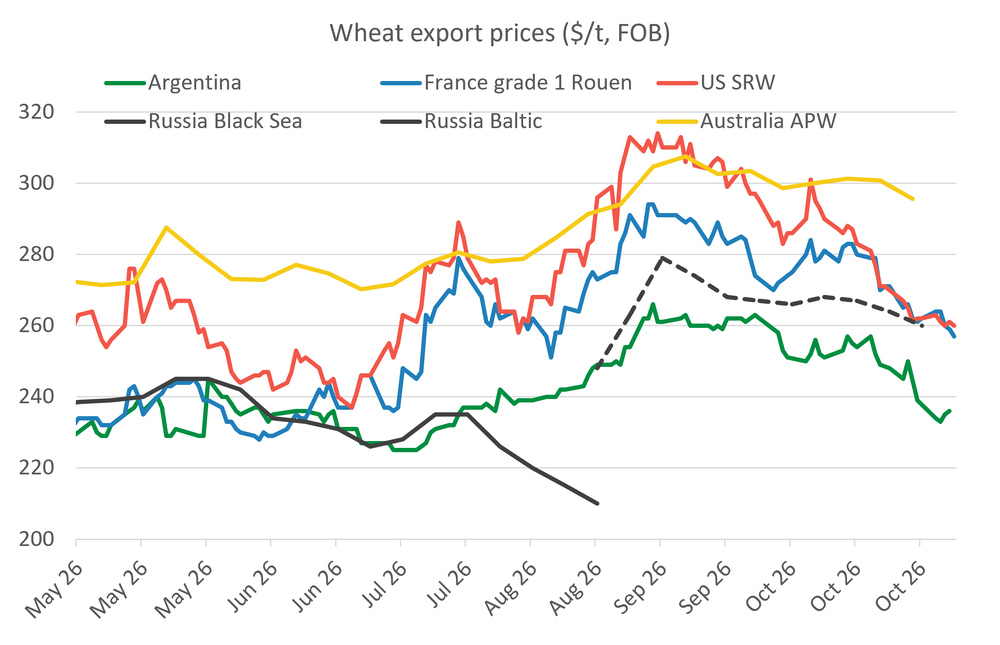
Signally, Argentine export prices - while they have sunk nearly $20/t FOB over the past month, reflecting seasonal pressure – remain more than $20/t above levels a year ago, when its farmers were harvesting 2025/26’s record 27.9Mt crop.
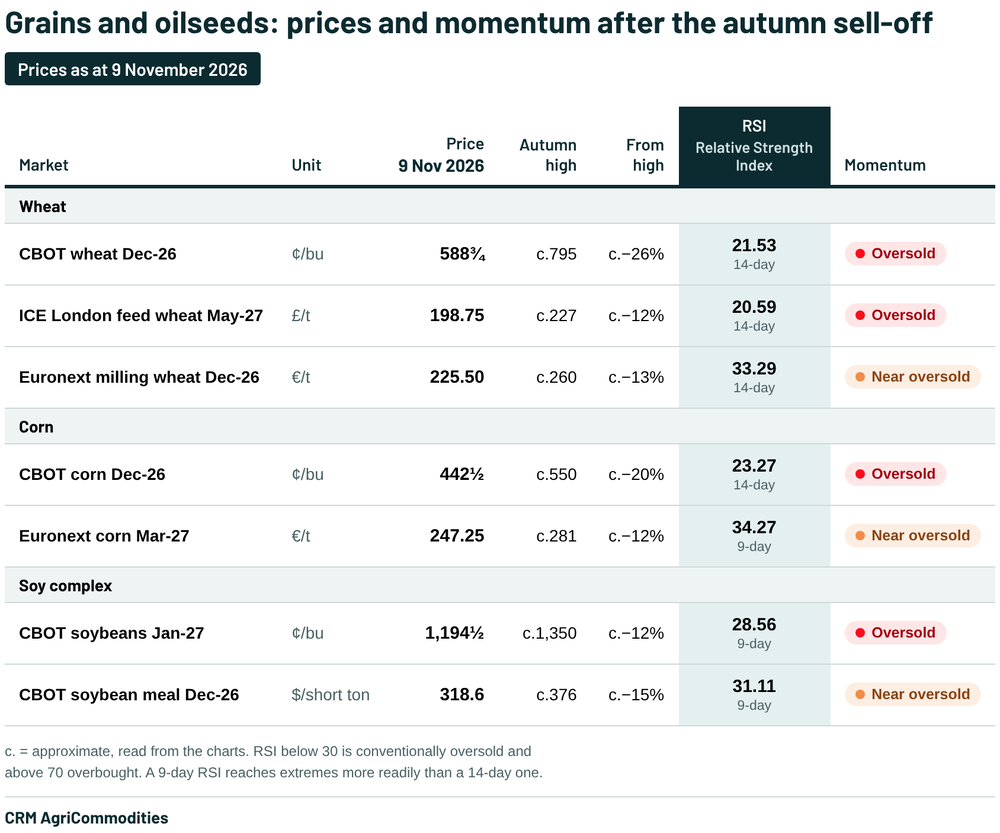
Still, wheat markets now around levels before the Black Sea shipping crisis began appear on many measures oversold. Chicago December-26 and London May-27 are, for instance, deep in oversold territory as measured by the 14-day relative strength index, a much-followed momentum indicator. Such a situation is often heralds a market turnaround.
Wheat looks cheaper versus rival corn as well. Sure, Paris wheat has for some time held an unusual discount to corn, currently at €24/t. (That compares with the premium of €10/t that Paris wheat has held to corn on average over the past decade.)
However, now Chicago wheat has lost most of the unusual buoyancy versus corn it gained from the weakest US all-wheat harvest in more than 50 years. Wheat’s premium has shrunk below $1.45/Bu spot basis, close to its 10-year average, for the first time since April, down from an August high of $2.55/Bu.
Certainly, there is still potential for more of the speculative selling which has fuelled the wheat price slide. Managed money still has scope to sell down in Paris particularly, where it retains a net long position, although headroom is smaller in Chicago, where funds have already built a net short of 87.1K contracts, the most since January.
However, price risks from current levels remain weighted to the upside, with ongoing geopolitical risks and curtailed exports from the Black Sea.
Corn opinion
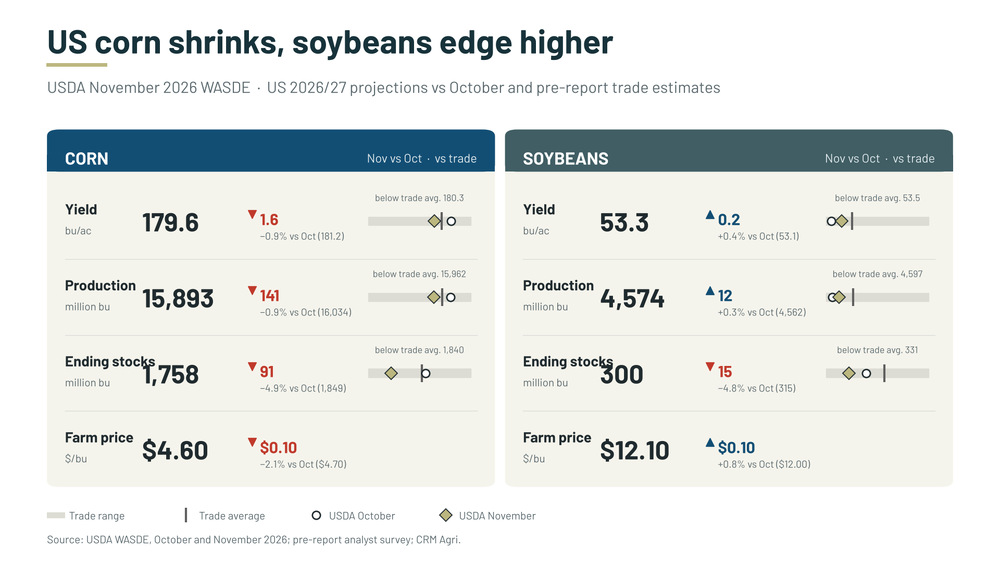
Corn futures have found support in Chicago at $4.40/Bu. There remains potential for further selling on a positive supply surprise, perhaps in Tuesday’s USDA Wasde briefing.
However, CRM Agri maintains that downside risk is limited, and that prices will stage some recovery through late Q4.
The Wasde report represents an obvious source of corn market surprise, given the uncertainty that there remains over the US harvest, even with more than 80% of now done.
Sure, traders on the face of it expect the USDA to downgrade its US yield estimate, by 0.9 bushels per acre to 180.3bpa, as measured by the consensus in a Reuters poll.
However, that number disguises underlying disagreement. Yield estimates for the November Wasde range from 173.2bpa to a high of 183.1bpa. Ie some traders expect an upgrade.
In production (and metric) terms, forecasts extend from 390-412Mt, versus the current 407.3Mt figure. The importance of this range is, of course, particularly important in its implications for carryout stocks, a key influence on prices. That supply range of 12Mt offers particular uncertainty when considered against US inventories currently expected to end 2026/27 at less than 47.0Mt.
Meanwhile, Argentina offers some cause for production upgrade, given an unusually fast pace of sowings. Plantings have reached the half-way point a month ahead of normal, accelerated by fears for El Nino-fuelled inundations disrupting fieldwork, but raising the question of whether farmers will ultimately plant more corn than has been expected.
This week’s Russia-Ukraine-US talks have weighed on prices too, given the potential for freeing up exports from Ukraine, the fourth-ranked exporters.
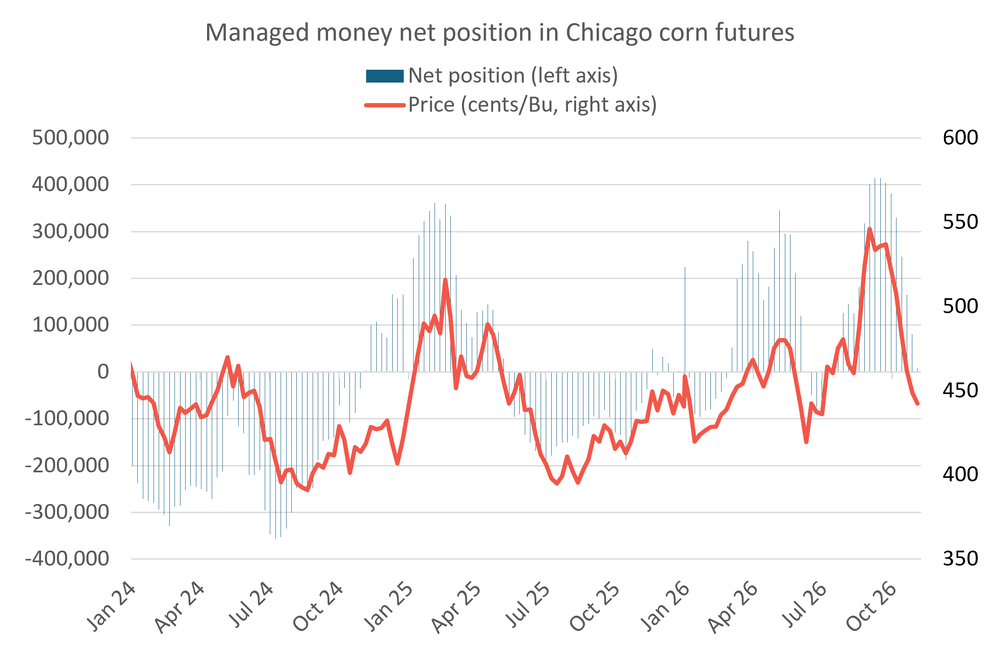
Still, similar to wheat, selling has positioned the market for recovery, should the talks founder, as previous ones have done.
Furthermore, not all surprises pose negative price risk. Besides the potential for a bigger-than-expected US corn yield downgrade, the demand side offers a foreseeable surprise too, in a return up the agenda of China’s interest in buying $17bn of US ag exports, besides soybeans, implying hefty corn purchases.
China said on Thursday that it was open to buying more US farm goods, but only if the two countries implement tariff cuts agreed in September.
That may provoke second thoughts among funds which have fuelled the recent corn price selldown by, over just seven weeks, slashing their net long in Chicago corn futures to 8.8K contracts, from a record 414.5K contracts.
European corn prices remain contained by US values, with the Paris premium to Chicago returning after its breakout in late October to back within the $90-110/t range needed to encourage imports. With the EU’s 2026/27 import requirement remaining substantial, we expect the premium to hold within that range until there is evidence of import acceleration, or elevated grain substitution, or the boost to export availability from South America’s 2026/27 crops next year.