Brazilian farmers have caught up a bit on their soybean harvesting, but remain behind in seedings of the follow-on safrinha corn crop.
Growers had seeded 21.6% of their safrinha corn as of Saturday, according to official crop bureau Conab.
That represented an increase of 9 points week on week, but remained behind the typical 25.5% seeded by then,
The disconnect is particularly marked in Mato Grosso, the top growing state for both crops, where research group Imea reports soybean sowings at 39.6% complete as of Friday, matching the fastest pace in recent years.
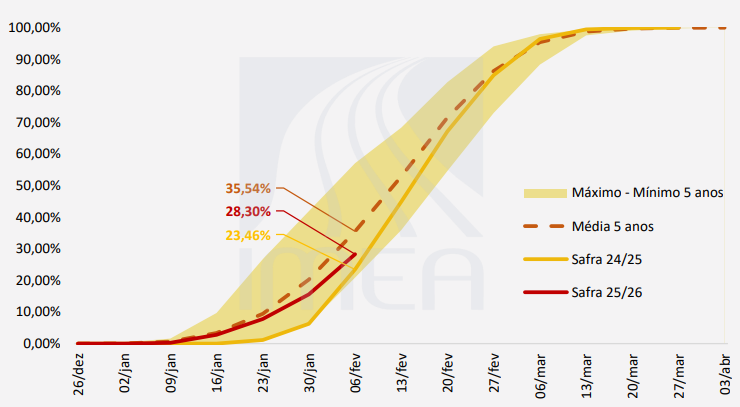
By contrast, safrinha corn sowings were, at 28.3% finished, well behind the five-year average of 35.5% (chart above).
That delay could prove significant, given that the ideal planting window for safrinha corn ends in less than three weeks. Crops seeded after this period risk pollinating in the midst of the region’s dry season, with the threat to yield this entails.
The soy-corn gap might reflect an unusual focus by growers on soybeans, to get crop quickly to port, before delivery of the bulk of what is expected to be a record harvest weighs further on prices.
However, it could also signal a reluctance by growers to plant as much safrinha corn as they had pencilled in, in the face of local prices more than 20% below year-ago levels, in Brazilian real terms.
Certainly, other evidence suggests that growers are mindful of the weaker prices. They have sold forward a below-average 32% of their safrinha corn crop so far, below the typical level.
The potential for smaller-than-expected, or late-running, safrinha corn sowings in Brazil presents upside risk to prices. Brazil’s safrinha corn crop is the primary source of its export supplies.
Weather this week
Western Europe faces a wet week ahead, before seeing some retreat in rainfall as February approaches its final week. Rainfall will remain persistent in Germany, and in the UK although drier conditions are expected heading towards March.
In eastern Europe and the Black Sea region, rains over the next week will be followed by a drier spell. Temperatures will remain above-average, with no return forecast of the recent cold weather which has sparked fears for crop damage.
In the US too, temperatures will prove above-average through the next fortnight, and well above recent lows. Rains expected for the US South and southern Plains this week will shift to the northern Midwest next week.
Brazil faces a wet fortnight ahead, including in key Centre South agricultural states such as Mato Grosso and Goias.
According to Conab, "rainfall will continue to be frequent and well-distributed in the region, maintaining favorable conditions" for developing crops, "without significant impacts on harvesting and sowing".
The rainfall will extend into northern Argentina too, particularly in the coming week. This could be a sign of the waning of La Nina, which is associated with Argentine dryness.