Investor positions can reveal useful insight about sentiment and overall market exposure to higher or lower prices, a key indication of this is the net fund position which provides a snapshot of the difference between the volume of long and short positions open in a market.

Funds are turning less bearish on wheat markets.
Market talk has it that the primary driver of recent recoveries in wheat prices is closure by funds of their short bets – ie positions which profit when prices fall.
Data support this assertion. In Chicago, managed money has cut its short positions by more than 20% over the past month. In Paris, the tally of short positions has shrunk by nearly 30% month on month, to the lowest in a year.
Factoring in changes in long bets too (ie holdings which profit when prices rise) to form the so-called “net long” position, funds are their least bearish on Chicago wheat since before Christmas (chart above), and in Paris wheat (chart below) since February last year.
Less clear is why funds are making this change.
Some traders hold that concerns over 2026 crops, including dryness in the US and wetness in Europe, are encouraging a change in heart.
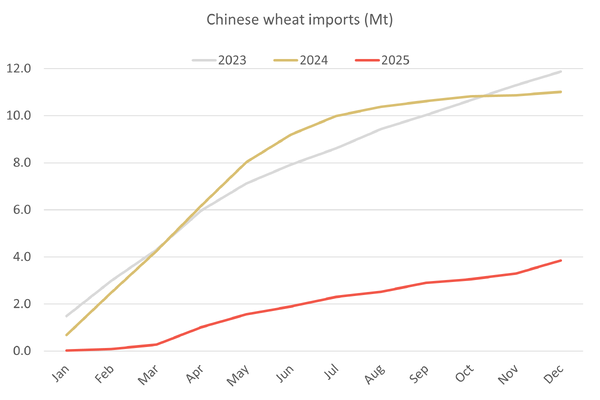
Others see potential for an uptick in demand by importers such as China and Turkey as spurring the retreat.
Changing technical assessments, and a change in underlying price trend from downwards to sideways, besides the weaker returns to be made by rolling positions forward, is likely playing a role too.

Fund positioning movements offer a useful insight into pricing trends. Whether by cause or effect, changes in funds’ net long position in wheat correlates nearly 80% with price moves in both Chicago and Paris.
Managed money’s net short positions of 69.6K contracts in Chicago, and of 82.2K contracts in Paris, offer some scope for further short closing and price support, albeit that much of the ammunition on this score has already been used.
Funds have a reluctance to move net long, ie to hold more long bets than short ones, in Chicago especially. They have not held a net long position there since 2022. Growers with crop to sell should not assume that the trend will continue.
Corn analysis

In Chicago corn futures, fund positioning shows no clear trend, bar some modest reversal of the significant selling undertaken after the USDA in January’s Wasde report issued a surprise upgrade to the 2025 US corn harvest.
The net short position of 42.3K contracts is neutral by historic standards. It is well below the record net short of 356.4K contracts, set in 2024, and an even larger distance from the record net long of 409.4K contracts set 15 years ago.
That suggests significant scope for fund buying or selling should a clear market narrative emerge. Factors such as the establishment of Brazil’s safrinha corn crop, and progress on US sowings, will be key to determining whether such a trend sets in.
Soybean analysis

Managed money has been a substantial buyer of Chicago soybean futures since Donald Trump in early February signalled the potential for China to buy an additional 8Mt of the oilseed from the US.
The following week, funds were net buyers of 86.7K soybean contracts, the most since May 2024, while purchasing a further 43.1K contracts the following week.
That left the net long position at 159.0K contracts, a reasonably high level, but still short of eg the 233.5K contracts reached in November, the last time prices jumped on the theme of Chinese purchases of US crop.
This suggests some scope for further fund buying although, if the November rally is a guide, it may be followed by rapid selling. Brazil’s ongoing harvest, for which estimates are rising, enhances the potential for a reversal.