Crop Watch - US crop ratings above average
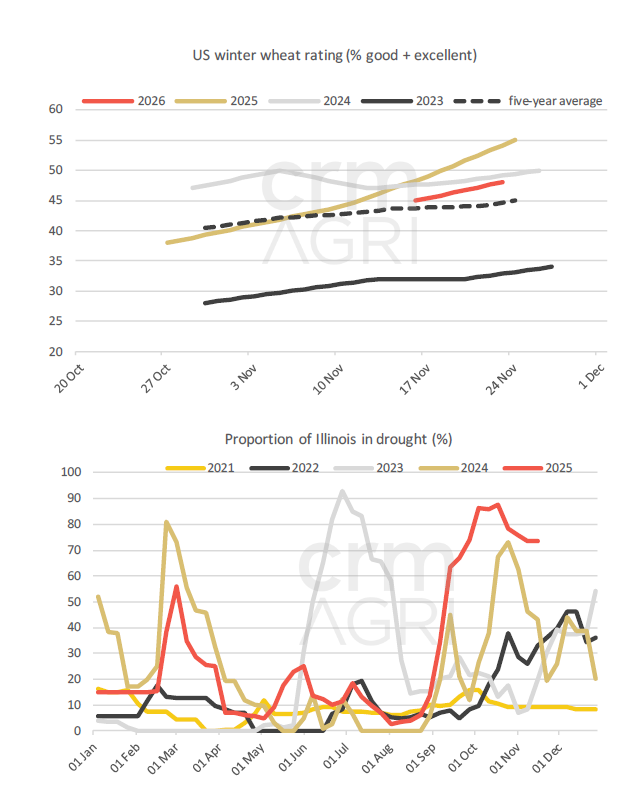
The USDA late on Monday reported a 3 point increase to 48% good or excellent in the proportion of the crop rated “good” or “excellent”. While that is above the five-year average of 45%, the mean factors in an unusually low 2022 reading.
Before the USDA resumed its crop progress reports, traders had been talking of ratings above 50%. Many of the states with lower condition ratings are
in the southern Plains, a region prone to dryness. The Oklahoma crop rating was 40% good or excellent, and the Texas one 26%.
Also among the more notable readings was a 56% one for Illinois, a major grower of soft red winter wheat, where November ratings have been above 70% in recent years.
The weaker start this time reflects unusually extensive drought (lower chart left). Nor is much rain expected over the next two weeks in Illinois to rebuild soil moisture levels.
Global conditions
Europe faces a mixed fortnight, in rainfall terms. Western areas, such as the UK and France, and eastern countries such as Romania face a wet
close to November. But Germany and central Europe will stay largely dry, a pattern that will expand east through the first week of December. The
UK and France, however, as well as north western Spain, will remain wet through the fortnight.
Temperatures will prove around average this week, before warming to above-normal levels in early December.
In the Black Sea region bar Romania, rainfall will prove sparse through the fortnight, while temperatures prove unseasonably warm.
The US Midwest faces a mixed fortnight too, with southern areas receiving ample rains, but weather maps removing moisture from outlooks for
more northern states such as Illinois (below) and Iowa. The Plains are expected to stay largely dry too, bar some eastern areas. Temperatures will
stay close to seasonal averages for the rest of November, before cooling into December.
In South America, the return of rains to central Brazil will gather momentum, with temperatures often showing a little below the norm. Argentina will
see further rainfall this week, to slow the progress of soybean plantings, before December brings drier conditions.
South Australia will see a wet finish to November too, accompanied by unusually cool conditions. Other grain growing areas will stay largely dry,
allowing for speedy harvesting.